
Payroll Tips for Small Business Owners

How to Manage Payroll Efficiently and Avoid Costly Mistakes
Managing payroll is one of the most important responsibilities for any business owner. It directly affects employee trust, tax compliance, and overall business stability. At the same time, it is one of the most common sources of administrative stress, especially for small and growing companies.
Payroll mistakes are rarely caused by negligence. More often, they happen because systems were never properly set up, processes grew organically without structure, or business owners simply ran out of time.
This guide breaks down practical payroll tips for small business owners who want to save time, reduce errors, and avoid unnecessary penalties. Whether you have a handful of employees or a growing team, the goal is the same: build a payroll process that works consistently without consuming your time every pay period.
Table of Contents
Why Payroll Becomes Difficult for Small Businesses
In the early stages of a business, payroll often feels simple. A few employees, straightforward pay structures, and limited reporting requirements make it manageable. As the business grows, complexity increases quickly.

Common challenges include:
- Tracking hourly employees or contractors accurately
- Managing overtime and changing schedules
- Handling payroll taxes and filing deadlines
- Keeping up with changing federal, state, and local regulations
- Supporting both employees and contractors
- Integrating payroll with accounting and reporting systems
What starts as a simple task can become a recurring operational risk. The key is understanding where problems typically occur and addressing payroll challenges early.
Payroll Tip #1: Understand Your True Payroll Cost
Many business owners think of payroll as wages plus taxes. In reality, payroll costs include much more:
- Employer payroll taxes
- Workers’ compensation
- Benefits and deductions
- Administrative time
- Compliance risk
- Software or payroll service costs
One of the most overlooked costs is time. When owners or managers spend hours correcting payroll errors or responding to tax notices, that time is taken away from revenue-producing work.Understanding the full cost of payroll helps determine whether your current process is actually efficient.

Payroll Tip #2: Set Up Payroll Correctly from Day One
Payroll problems are often the result of early shortcuts. Incorrect employee classifications, inconsistent pay codes, or unclear policies create ongoing issues that compound over time.
A solid foundation includes:
- Proper employee vs. contractor classification
- Clear pay schedules
- Standardized time tracking rules
- Documented overtime policies
- Consistent approval workflows
Fixing payroll later is always more expensive than setting it up correctly from the beginning.
Payroll Tip #3: Centralize Time Tracking and Approvals
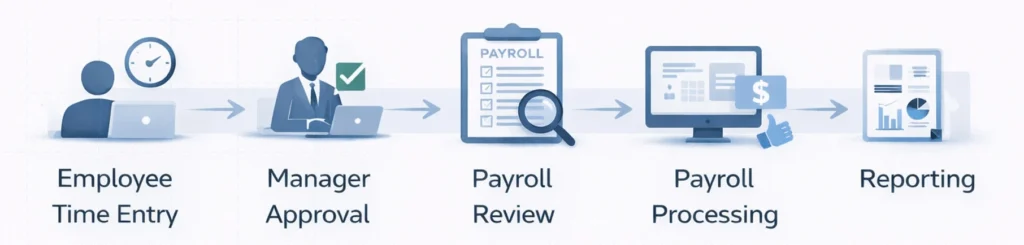
One of the most effective payroll management tips for small businesses is reducing the number of places payroll data lives.
Errors commonly happen when hours come from:
- Emails or text messages
- Paper time sheets
- Multiple tracking systems
- Manual adjustments without documentation
Centralizing time tracking ensures payroll is based on one verified source of information. This reduces disputes, improves accuracy, and shortens payroll processing time.
Payroll Tip #4: Standardize Your Payroll Process
Consistency reduces mistakes. Every payroll run should follow the same sequence:
- Collect and verify time data
- Review exceptions and changes
- Approve payroll internally
- Process payroll
- Confirm tax calculations and reports
Standardizing this process is essential for payroll process optimization and makes payroll predictable and easier to delegate as your business grows.
Payroll Tip #5: Stay Ahead of Payroll Tax Compliance
Payroll tax errors are among the most expensive mistakes small businesses make. Late filings or incorrect deposits can result in penalties even when the error was unintentional.
Common issues include:
- Missing filing deadlines
- Incorrect tax rates
- Misreported wages
- Failure to update employee information
Business owners often ask how to avoid payroll tax penalties. The answer is consistency and oversight. Payroll taxes must be handled accurately every pay period, not just at quarter or year end.
Struggling with Payroll Compliance?
Payroll Tip #6: Use Automation Where It Actually Helps
Automation can reduce repetitive work, but only when the underlying process is correct. Automating a flawed workflow simply produces faster mistakes.
Automation works best for:
- Recurring payroll calculations
- Tax filings and reporting
- Direct deposit processing
- Report generation
It should not replace review or approval steps, especially as employee counts increase.
Payroll Tip #7: Adjust Your Payroll Approach as You Grow
Payroll needs change significantly depending on company size and complexity. Recognizing when your payroll process has outgrown its original setup prevents future disruption.
Payroll is usually owner-managed. The focus should be on accuracy and compliance rather than speed.
Complexity increases with multiple pay types, overtime, and reporting requirements. Structured workflows become essential.
Payroll becomes operational infrastructure. Integration with accounting systems, access controls, and reporting accuracy become critical.
Payroll Tip #8: Understand Common Payroll Rules and Misconceptions
If you’re searching for payroll tips for small business owners, you’re usually trying to solve the same few issues: time tracking rules, payroll cost questions, and avoiding mistakes that create rework. The FAQs below cover the most common payroll myths and payroll process optimization best practices to help you run payroll with fewer surprises.
What is the 7-minute rule for payroll?
The 7-minute rule allows employers to round employee time to the nearest quarter hour, provided it benefits employees and employers equally over time and is applied consistently.
What is the simplest way to run payroll for a small business?
The simplest approach is one that minimizes manual entry and ensures tax compliance automatically. For many businesses, this means using a structured payroll system or service rather than manual calculations.
Is it cheaper to do payroll yourself or outsource?
Doing payroll internally may appear cheaper at first, but the cost of time, errors, and compliance risk often outweighs the savings as businesses grow.
How much should payroll cost per employee?
Costs vary depending on complexity, frequency, and services included. The real comparison should consider time saved and risk reduced, not just per-employee pricing.
Payroll Tip #9: Focus on Risk Reduction, Not Just Speed
Fast payroll is not necessarily good payroll. The goal is accurate, compliant payroll that runs consistently without surprises.
Reducing risk means:
- Maintaining accurate records
- Keeping employee data current
- Reviewing payroll before submission
- Ensuring taxes are handled correctly
Small mistakes repeated over time become large problems. Reliable processes prevent this.
Payroll Tip #10: Build a Payroll System That Lets You Focus on Your Business
Payroll should support your business, not compete with it for attention. When payroll becomes stressful or time-consuming, it is usually a signal that the process needs to evolve.
Business owners often reach a point where managing payroll internally no longer makes sense, especially when growth increases complexity.
When It Makes Sense to Get Help with Payroll
Many small business owners start by managing payroll themselves. Over time, priorities shift. The focus moves from simply running payroll to running the business.
Southern Payroll Services has worked with businesses across the Atlanta and Suwanee areas for more than 40 years, helping owners simplify payroll while staying compliant with federal, state, and local tax requirements. Our approach combines modern payroll technology with direct, personal service, allowing businesses to choose how involved they want to be in the process.
For companies that want payroll handled accurately without losing visibility or control, working with a local payroll partner can remove a significant administrative burden while reducing risk.
If you are evaluating your current payroll process or looking for ways to optimize your payroll, Southern Payroll Services can help you identify where improvements can be made and what approach makes the most sense for your business.