
Payroll Solutions for Restaurants: A Practical Guide for Owners and Operators

Explore payroll solutions for restaurants, including tips, hourly pay, overtime, tax filing, and ways to simplify payroll for busy operators.

man experiencing headaches from payroll challenges for his restaurant

Restaurant payroll can get messy fast. One employee picks up shifts at two locations, another earns tips, another works overtime during a busy weekend, and someone forgets to approve timecards before payroll closes. By the time you are trying to run payroll, you are not just paying people. You are sorting through hours, roles, tips, taxes, and compliance details that can easily lead to mistakes.

That is why many operators start looking for payroll solutions for restaurants that are built for the realities of hourly work. A good process should help you pay people accurately, keep records organized, and reduce the amount of manual cleanup happening every pay period.

In this guide, you will learn how restaurant payroll works, why it often breaks down, what problems show up most often, and what a more reliable payroll process can look like for a small restaurant or multi-location operation.
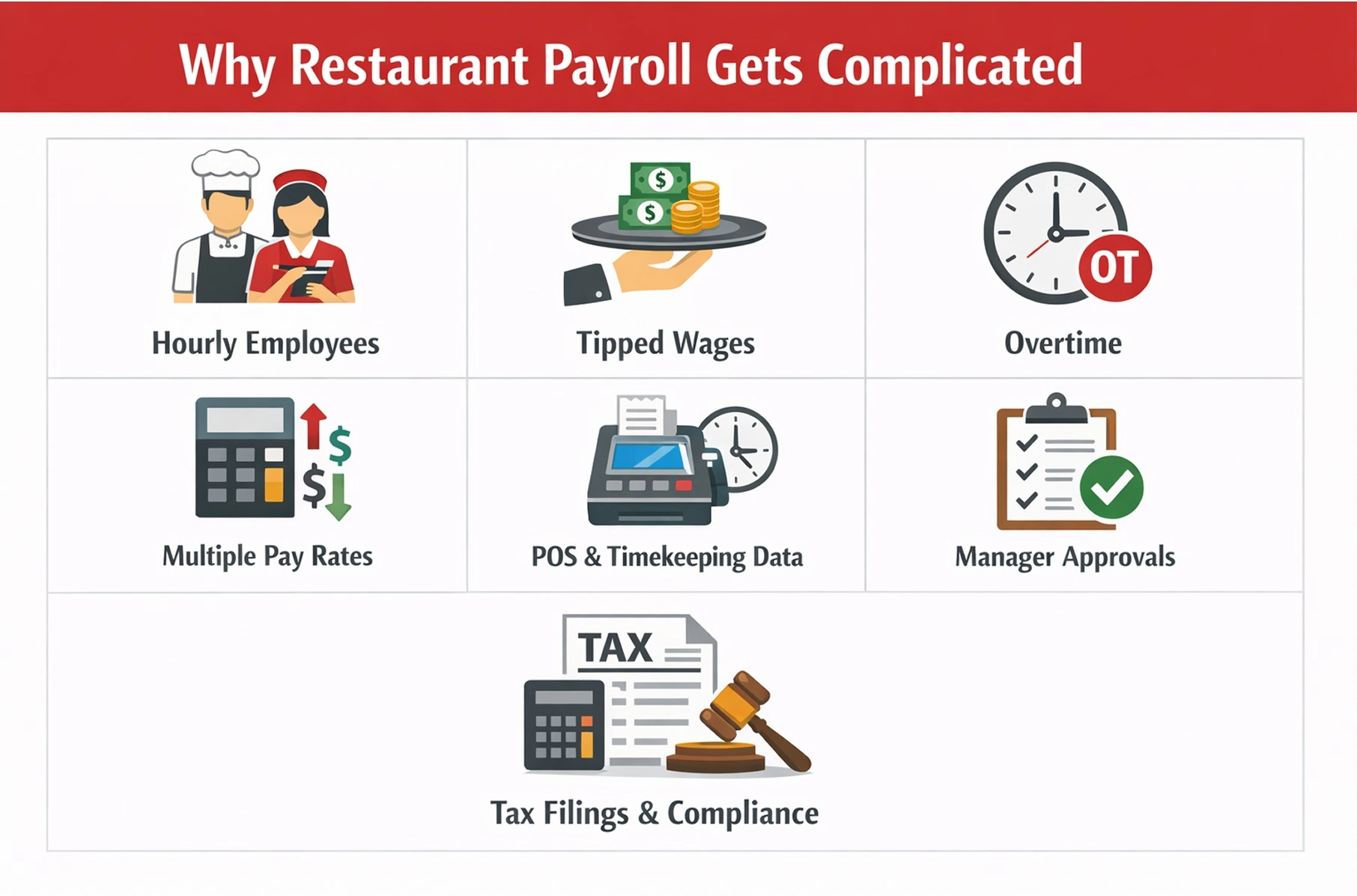
why restaurant payroll is complicated

Why restaurant payroll problems happen

Most restaurant payroll issues are not caused by carelessness. They usually happen because restaurant operations move quickly and payroll has to keep up. Restaurants often deal with:
  • Hourly employees with changing schedules
  • Tipped employees and tip reporting rules
  • Multiple pay rates or job roles
  • Overtime that changes week to week
  • PTO, reimbursements, and shift coverage changes
  • Manual entry between POS, scheduling, and payroll systems
  • Managers approving hours late or inconsistently
That combination creates friction. A payroll process that worked when you had 8 employees may start breaking down at 20. A spreadsheet that seemed manageable may turn into a liability when you have tipped wages, off-cycle checks, corrections, and turnover. This is also why many restaurant owners outgrow generic payroll tools. Articles ranking well for this topic consistently emphasize tip handling, hourly time tracking, overtime, and POS integration because those are the pressure points restaurants deal with every week.

The most common payroll challenges for restaurants
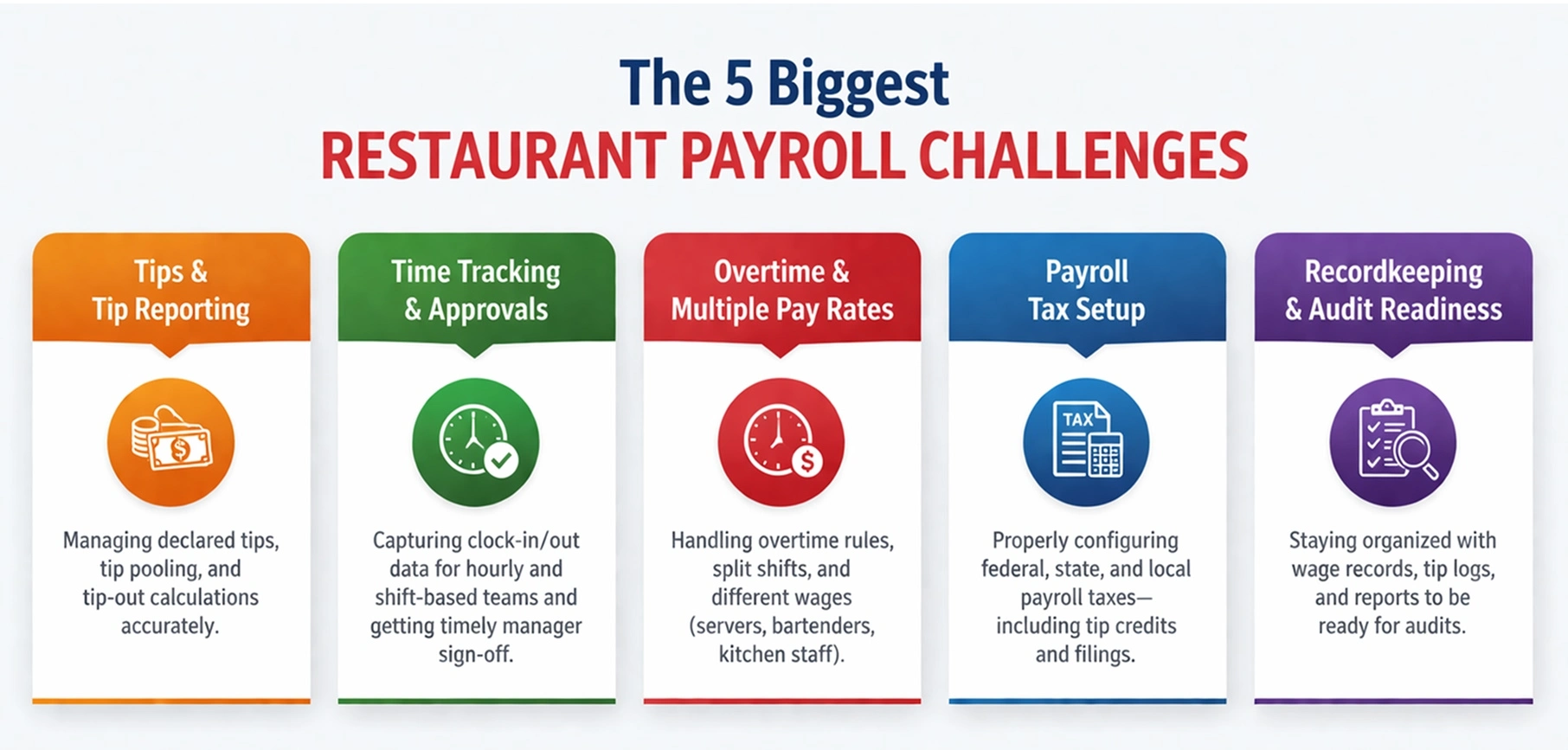
Tipped wages, tip reporting, and tip credits

Restaurants often employ workers whose pay includes both direct wages and tips. That adds complexity that many businesses outside hospitality never deal with.

A common scenario: a full-service restaurant has servers, bartenders, hosts, and support staff. Some tips are direct. Some are pooled. Some are paid out through payroll and some are recorded from POS data. If the rules are not clearly set up, payroll can easily reflect the wrong taxable wages or the wrong tip amounts.

Why it matters:
Tip handling errors may create wage issues, tax problems, and employee distrust. The IRS requires employers to retain tip reports and withhold applicable taxes based on wages and reported tips. Employees receiving $20 or more in cash tips in a month generally must report those tips to the employer by the 10th day of the following month. The U.S. Department of Labor also states that tip credit rules have specific requirements, and employers using a tip credit must ensure direct wages plus tips equal at least the required minimum wage and overtime compensation.
 
How to prevent it:

  1. Set a written policy for tip reporting and tip pooling.
  2. Make sure payroll receives tip data in a consistent format each pay period.
  3. Confirm that tipped and non-tipped roles are coded correctly in the payroll system.
  4. Review state and local rules before applying any tip credit.
  5. Reconcile POS tip data against payroll reports before final approval.

For restaurants, this is one reason restaurant payroll software for hourly employees and outsourced payroll support can be valuable. These setups tend to reduce manual calculations around tips and taxable wages.

Time tracking and approval breakdowns

In restaurants, hours change constantly. Employees trade shifts, clock in early, miss punches, or work split shifts. If time data is not captured cleanly, payroll suffers.

A common scenario: a manager exports hours from the POS, then edits missed punches manually, then emails final numbers to whoever processes payroll. By payroll day, nobody is fully sure which version is right.

Why it matters:
Bad time data leads to underpayments, overpayments, and wasted time fixing payroll after the fact. It also creates friction with employees who want to know why their check looks wrong. Strong timekeeping and system integration are repeatedly highlighted in top-ranking restaurant payroll content for exactly this reason.

How to prevent it:

  1. Use one primary source of truth for hours worked.
  2. Set a clear deadline for timecard review and approval.
  3. Require managers to resolve missed punches before payroll processing begins.
  4. Limit manual edits and document any changes made after export.
  5. Connect payroll with POS, scheduling, or time-tracking tools where possible.

Overtime, multiple pay rates, and inconsistent pay rules

Restaurant employees do not always work under one simple pay structure. An employee may work one shift as a server and another as a trainer. Another may have a different rate for catering work or banquet events. Overtime can also get missed when managers focus only on schedules, not total hours worked.

A common scenario: an employee works in two roles in the same workweek, but the payroll system is not configured to calculate pay correctly across both rates. The result is a check that looks off, followed by a manual correction.

Why it matters:
Pay errors often hurt employee trust faster than almost anything else. They also force managers into reactive cleanup instead of proactive control. Several restaurant payroll guides point to fluctuating hours, overtime, and multiple rates as recurring trouble spots in payroll administration.

How to prevent it:

  1. Create standard pay codes for each role and compensation type.
  2. Train managers on when rate changes must be reported.
  3. Review overtime weekly, not just at payroll close.
  4. Audit employee setup regularly to catch outdated pay rates.
  5. Run a pre-processing review for anyone with multiple job codes.

Payroll tax setup and filing errors

Even when gross pay is correct, payroll can still go wrong if tax setup is off. Restaurants may deal with frequent hiring, turnover, and changing employee details, which makes setup errors more likely.

A common scenario: a new employee is onboarded quickly before a busy weekend, but withholding information is incomplete or entered incorrectly. The employee gets paid, but the tax setup needs correction later.

Why it matters:
Tax errors may trigger notices, amended filings, penalties, or extra admin work. IRS Publication 15 is still a core reference point for employer payroll tax responsibilities, including withholding, depositing, reporting, and paying employment taxes.

How to prevent it:

  1. Use a standard onboarding checklist before the first payroll run.
  2. Verify employee tax forms and withholding setup before processing payroll.
  3. Keep payroll tax filing responsibilities clearly assigned.
  4. Reconcile payroll registers to tax filings on a regular schedule.
  5. Use a provider that stays current on filing requirements and deadlines.

For many operators, this is where outsourced support starts to make sense. Instead of treating tax filing as an afterthought, a stronger payroll process builds it into the workflow from the start.

Poor recordkeeping and weak audit readiness

Restaurants are busy. Records often end up scattered across email, paper notes, spreadsheets, POS exports, and payroll reports. That works until someone has a question about pay from three months ago.

A common scenario: an employee disputes hours or tip reporting, and the restaurant has to search multiple systems to reconstruct what happened. Nothing is fully missing, but nothing is easy to verify either.

Why it matters:
Poor records make every correction harder. They also make it more difficult to respond to tax notices, wage questions, or internal reviews. The IRS and labor agencies expect employers to maintain payroll and tip-related records, not rely on memory or informal manager notes.

How to prevent it:

  1. Store payroll reports in one consistent location.
  2. Keep time edits, pay changes, and approvals documented.
  3. Retain employee tip reporting records and payroll summaries.
  4. Standardize naming and filing conventions for each pay period.
  5. Review recordkeeping practices quarterly, especially after staffing changes.

Outgrowing generic software that was never built for restaurants

Some restaurants start with basic payroll tools because they are easy to adopt. That can work for a while. But problems show up when the business adds tipped roles, shift complexity, multiple managers, or multiple locations.

A common scenario: payroll technically runs, but the restaurant still relies on side spreadsheets, manual imports, and repeated adjustments. At that point, software is not really solving the problem. It is just one part of a patchwork process.

Why it matters:
A generic tool may process paychecks, but still leave your team doing too much manual work around tips, shift pay, labor reporting, and reconciliation. The strongest restaurant payroll software content currently ranking tends to focus on industry-specific needs such as POS integration, tip handling, and hourly workforce support for exactly this reason.

How to prevent it:

  1. Map your current payroll workflow from time capture to final reports.
  2. Identify every manual handoff in the process.
  3. Separate true payroll needs from nice-to-have software features.
  4. Prioritize support for hourly employees, tips, and tax handling.
  5. Choose a provider that can adapt to your process, not just force you into theirs.

Quick self-check: can your restaurant payroll process hold up?

Use this two-minute check to gauge whether your current payroll process may be riskier than it looks.

You may have a payroll process problem if:

  • Managers approve hours differently from one location to another
  • Payroll relies on spreadsheets or repeated manual adjustments
  • Tip data is reviewed late or inconsistently
  • Employees often ask why a check looks wrong
  • Overtime is caught after payroll instead of before it
  • Payroll tax notices are treated as routine
  • You cannot quickly trace one paycheck from time entry to final pay
  • You are using software that does not clearly support restaurant pay structures

If two or three of those sound familiar, it is worth tightening the process before the next busy season exposes bigger issues.

What a better payroll process looks like

A better payroll process is not necessarily complicated. It is just more controlled.

A simple restaurant payroll process framework often looks like this:

1. Capture time accurately

Hours should come from a consistent source, ideally connected to your POS, scheduling, or timekeeping workflow.

2. Review exceptions before payroll starts

Managers should resolve missed punches, unusual overtime, role changes, reimbursements, and tip issues before payroll is submitted.

3. Standardize payroll inputs

Use the same pay codes, reporting rules, and approval cutoffs every pay period.

4. Validate payroll before final processing

Review gross wages, overtime, tips, deductions, and taxes before releasing payroll.

5. Keep filing and reporting organized

Store reports, confirmations, and employee records in a way that makes sense later, not just today.

6. Assign ownership clearly

Shared responsibility often leads to payroll errors. A structured Payroll Center eliminates scattered spreadsheets by assigning clear ownership for employee setup, tax handling, and final reviews. Bring your process together to cut down on corrections, boost visibility, and ensure more predictable pay periods.

For restaurants, that often means combining practical tools with real support. Southern Payroll Services offers flexible processing options, online access, tax filing support, and payroll features that can be customized to business needs, including restaurant-related needs like FICA tip credit support. It also emphasizes one-to-one service rather than a call-center model, which can matter when payroll questions are time-sensitive. 

Restaurant Payroll FAQs

How to do payroll for a restaurant?

Start by choosing a payroll schedule, collecting approved time data, reviewing tips and pay adjustments, validating tax setup, and processing payroll through a system that can handle hourly staff accurately. For many restaurants, the hardest part is not the paycheck itself. It is getting clean inputs from timekeeping, tips, and managers before payroll is run.

What should payroll be for a restaurant?

There is no universal target because labor costs vary by concept, service model, location, and staffing approach. What matters is that payroll is accurate, consistent, and visible. A strong process helps you understand labor cost by role, shift, or department instead of only seeing payroll as one large total.

How to choose a restaurant payroll provider?

Look for a provider that can handle hourly employees, tips, overtime, tax filings, and restaurant-specific workflows. Ask how they deal with approvals, corrections, integrations, reporting, and support when something goes wrong. A provider that works well for a law office or retail store may not be the right fit for a restaurant.

restaurant employee - female - smiling because she is about to get paid through ideal payroll processes

Restaurant payroll is rarely simple. Between tipped employees, shifting hours, multiple pay rates, overtime, and tax requirements, even a well-run restaurant can end up spending too much time fixing payroll instead of confidently managing it.

For Georgia-based restaurants, staying current with Georgia labor requirements is another important part of maintaining a reliable payroll process.

That is why the right payroll solution matters. A stronger process can help reduce mistakes, protect employee trust, improve recordkeeping, and take pressure off owners and managers who already have enough to handle.

For restaurants that are tired of patching payroll together, Southern Payroll Services offers a more practical path. The company has more than 40 years of experience, a strong retention rate, flexible payroll processing options, tax support, and personalized service designed to fit how real businesses actually operate. For restaurant owners, that means getting help from people who understand that payroll is not just about checks. It is about keeping the business running smoothly and keeping your team paid accurately and on time.

Not sure if your current payroll process can keep up with your restaurant?

Get a practical review of your payroll setup and where it may be costing you time.