
Construction Company Payroll: How It Works

Learn how construction payroll works, what makes it unique, and how to choose the right construction payroll provider for accurate pay and cleaner reporting.

construction employees on job site

Construction payroll is one of those things that seems straightforward until you’re the one chasing timecards at 9 p.m., trying to allocate hours to three job sites, and fixing pay rates that changed mid-week. If you’ve felt that pain, you’re not alone. Working with a reliable construction payroll provider can make the difference between payroll being a weekly fire drill and payroll being a repeatable process your team can trust.

This guide explains what construction payroll is, why it’s different from standard payroll, and what challenges contractors run into most often. We’ll also cover what to look for in a construction payroll system, how payroll services for construction companies typically work, and the quick self-check signs that tell you it’s time to tighten up your process.
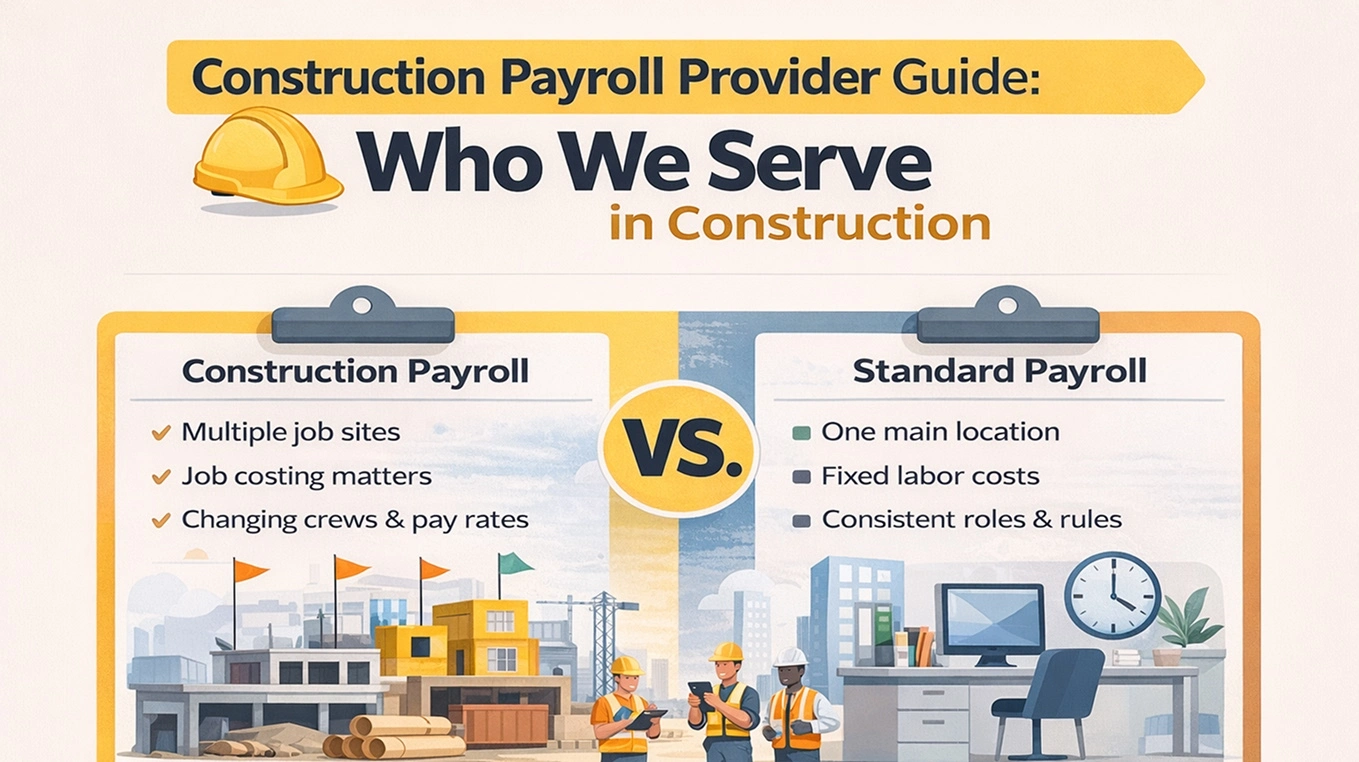
Summary

What is construction payroll (and why it matters)

Construction payroll is the process of paying employees and contractors accurately and on time while tracking labor across job sites, roles, and pay rates. That sounds simple, but construction adds moving parts other industries rarely deal with:

  • Employees may work on multiple jobs in the same pay period
  • Pay rates may change by task, classification, or site
  • Crews may include hourly, salaried, and 1099 workers
  • Time entry often happens in the field, not at a desk
  • Reporting matters because labor drives job profitability

When payroll runs clean, your team gets paid correctly, labor reporting is reliable, and you can make better decisions about staffing and job costs. When payroll runs messy, the fallout shows up fast: disputes, rework, and financial blind spots.

Why construction payroll is unique (and where things go wrong)

Construction payroll issues don’t usually come from a lack of effort. They come from complexity. In construction, the “inputs” payroll needs are often decentralized: foremen, PMs, timekeeping tools, job codes, and last-minute changes. A few common reasons payroll breaks down in construction:
  • Field-first operations: time is captured on-site, sometimes under pressure 
  • Project-based labor: people bounce between jobs, tasks, and rates 
  • Variable pay: overtime, per diem, travel, reimbursements, shift differentials 
  • Tighter margins: errors hit harder when labor is your biggest cost line 
  • Reporting needs: job costing and labor allocation can’t be an afterthought 
That’s why many contractors eventually look for payroll services for construction companies that can support both the pay run and the reporting discipline that goes with it.

The most common construction payroll challenges (grouped by theme)

Job costing and labor allocation (hours across jobs, phases, and tasks)

What happens:

Hours get tracked, but not tracked in a way that’s usable. Employees work on multiple jobs, but the job codes are unclear, or hours get dumped into one bucket at the end of the week.

Realistic example:

A framing crew works on two projects in the same pay period. Timecards come in with “8 hours” each day, but no job breakdown. Payroll pays correctly, but job costing is now guesswork. 

Why it matters:

If job costing data is unreliable, your labor reports won’t match reality. That affects estimating, profitability tracking, and staffing decisions.

How to prevent it (tactical steps):
  1. Use a simple, consistent job code list (job + phase + task if needed). 
  2. Require job allocation at time entry, not after payroll runs. 
  3. Keep job codes short and field-friendly (avoid complicated naming). 
  4. Review “unassigned” or “misc” hours before processing payroll. 
  5. Run a weekly labor report by job so problems show up early.

Multiple pay rates, classifications, and “same worker, different role”

What happens:

A worker performs different duties at different rates, or the pay rate changes based on role, site, or task. If this isn’t tracked cleanly, payroll mistakes happen.

Realistic example:

An employee works as a laborer on one site and an equipment operator on another. The foreman reports hours but doesn’t specify which hours were at which rate. Payroll defaults to the usual rate, and the employee catches it later.

Why it matters:

Pay disputes erode trust and create rework. If this happens regularly, it also becomes a retention issue in a labor-competitive market.

How to prevent it (tactical steps):
  1. Define pay types and rates by role in advance (laborer, operator, lead, etc.). 
  2. Require role selection at time entry when multiple rates apply. 
  3. Set clear rules for overtime calculation when multiple rates occur. 
  4. Train supervisors on “what payroll needs” in plain language. 
  5. Audit pay changes monthly: rate changes, promotions, temporary assignments.

Union payroll, deductions, and contribution tracking

What happens:

Union payroll can include specific deductions, fringes, and reporting requirements. Even when your team is trying to do it right, complexity increases fast if the system doesn’t support it.

Realistic example:

A contractor brings on a union crew for a specific project. Payroll is processed using the company’s usual setup. Later, the contractor realizes deductions and contributions weren’t handled the way the agreement required.

Why it matters:

Incorrect union payroll can create disputes, corrections, and strained labor relationships. It’s also expensive in admin time.

How to prevent it (tactical steps):
  1. Set up union-specific deduction profiles before the first pay run.
  2. Keep a clear mapping: employee → union → job → deduction set.
  3. Standardize documentation for manual changes (who, why, when).
  4. Confirm reporting requirements for your union arrangement.
  5. Use a construction payroll system that supports flexible deductions and reporting.

Certified payroll and public project reporting (when documentation is everything)

What happens:

On public projects, payroll often requires more documentation and structured reporting. If the process is informal, the reporting becomes a scramble.

Realistic example:

A contractor wins a public project with tighter labor reporting expectations. Payroll runs, but job classifications and hour tracking weren’t set up cleanly. Now the company is reconstructing records after the fact.

Why it matters:

Public project reporting is time-sensitive and detail-heavy. When records aren’t clean, it creates stress, rework, and risk.

How to prevent it (tactical steps):
  1. Confirm job classifications and pay rules before work begins.
  2. Ensure time tracking supports job and classification level detail.
  3. Store payroll reports in a consistent folder structure per project.
  4. Run an internal “report-ready” review weekly (not monthly).
  5. Assign one owner responsible for public project payroll reporting.

Time tracking and approvals (field reality vs payroll deadlines)

What happens:

Field timekeeping is the most common failure point. Missing punches, late timecards, and undocumented edits force payroll into last-minute judgment calls.

Realistic example:

A foreman texts hours to the office on Sunday night. Someone enters them manually. A missed clock-out gets “fixed” without notes. Later, an employee disputes the check and no one can confidently explain what happened.

Why it matters:

This creates payroll accuracy problems, disputes, and overtime issues. It also trains your business to accept rework as normal.

How to prevent it (tactical steps):
  1. Centralize time tracking in one system (not texts and emails).
  2. Set a firm time entry deadline and a separate approval deadline.
  3. Require documentation for manual edits (who edited, why, when).
  4. Review exceptions before processing (missed punches, OT spikes).
  5. Define who can approve time and what approval actually means.

Quick self-check: diagnose construction payroll risk in 2 minutes
If you check two or more of the items below, your construction payroll process may be carrying more risk (and rework) than you think:

    • Hours are submitted late or changed after approval
    • Job codes are inconsistent or often left blank
    • “Misc labor” is common in job costing reports
    • Pay corrections happen most months
    • Overtime is regularly disputed or surprises you
    • One person is the only one who understands payroll
    • Union deductions or special deductions are handled manually
    • Reporting doesn’t match what accounting expects
    • Public project reporting feels like rebuilding history each week

What a better construction payroll process looks like (simple framework)

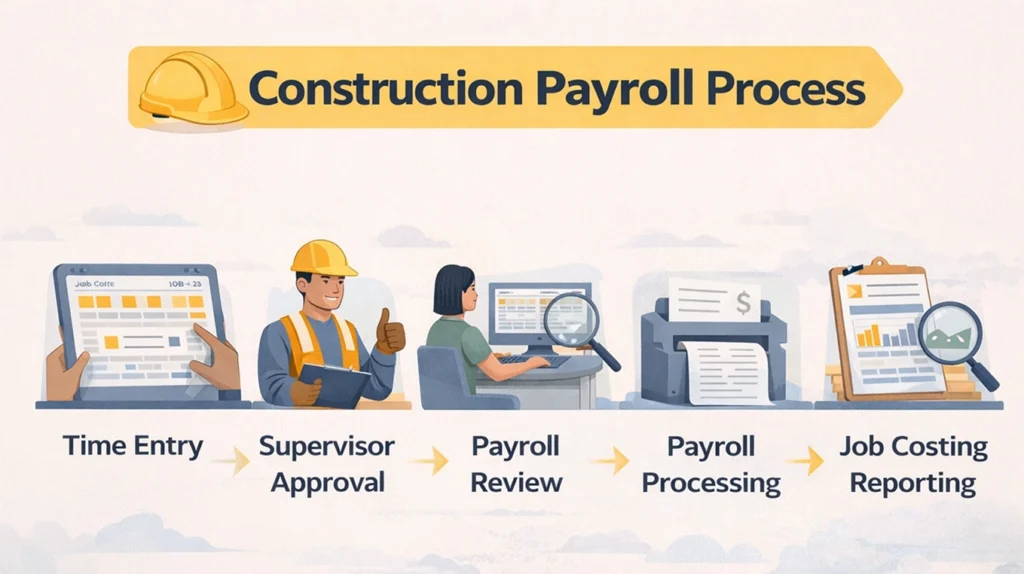
A better process doesn’t mean “more software.” It means clearer inputs, cleaner approvals, and reporting that’s built into payroll—not bolted on afterward. Here’s a straightforward framework many construction payroll companies and contractor payroll teams aim for:
  1. Field time entry (with job codes built in)
    • One method, one deadline
    • Job + phase + task codes are field-friendly
  2. Supervisor approval (clear accountability)
    • Foreman or PM approves by cutoff
    • Exceptions documented (missed punches, role changes, per diem)
  3. Payroll review (before money moves)
    • Verify high-risk areas: multiple rates, overtime, deductions, job allocation
    • Spot-check job costing totals
  4. Payroll processing (repeatable, consistent)
    • Standard checklist
    • Confirm pay types and changes
  5. Reporting (job costing + labor visibility)
    • Run labor reports by job weekly
    • Store reports consistently per project
This is where a “Payroll Center” approach matters. Instead of treating payroll as just a pay run, a Payroll Center approach coordinates setup, supports multiple processing methods, and helps keep reporting and compliance organized without making your team rebuild the process every week.

FAQs about construction payroll

Construction payroll brings up very specific “how-to” questions—especially around union work, certified payroll, and running payroll across job sites. Below are quick answers to common questions contractors ask when they’re trying to tighten up their process or choose the right construction payroll provider.

How to do construction payroll?

Construction payroll typically starts with accurate field time entry tied to job codes, followed by supervisor approval, payroll review for pay rates and overtime, and then processing and reporting. The key difference is that job costing and role-based pay often need to be captured before payroll runs.

How to do payroll for a construction company?

A construction company payroll process should include job allocation, multiple pay rates when applicable, clear approval deadlines, and consistent reporting. Many contractors benefit from using payroll services for construction companies that can support both payroll processing and job-level reporting needs.

How to run payroll for unionized employees?

Union payroll usually requires specific deductions and contribution handling based on the agreement and job. The safest approach is to set up union deduction profiles before the first pay run and keep clear documentation for any manual changes.

What is certified payroll for construction?

Certified payroll is a reporting requirement commonly tied to public projects. It typically involves documenting worker classifications, hours, pay rates, deductions, and wages paid in a structured format.

Getting time tracking and job classifications right upfront is what makes certified payroll manageable.

Construction payroll shouldn’t slow down your job sites

construction employees working onsite - time tracking to be entered into construction payroll solution system

Construction is demanding enough without payroll becoming a weekly scramble. When job codes, pay rates, approvals, and reporting aren’t aligned, payroll turns into rework—and rework costs money. The contractors who run payroll smoothly usually aren’t doing anything magical. They’ve just built a process that matches how construction actually works: job-based labor, field-first time entry, and reporting that matters.


Southern Payroll Services supports contractors and construction businesses with flexible processing options and personal support—so you can run payroll online, or work directly with a payroll specialist, depending on what fits your operation. We help businesses set up payroll the right way, keep reporting organized, and reduce the errors that cause pay disputes and admin pileups.

If your construction payroll process is starting to feel too complex to manage with DIY tools, it may be time to simplify the system—not just push harder on the same process.

Want to know if your current construction payroll process is costing you time or job-costing accuracy?

Get a quick review from a Southern Payroll Services specialist. We’ll help you identify the weak points—job codes, approvals, pay rates, deductions, or reporting—and what to fix first.